In this Q&A with Emmet and Mikael, they answer more questions from you, our listeners. Covering how to measure where you’re at with your handstand training, how Emmet and Mikael met and decided to collaborate on Handstand Factory, our first audio user submitted question on fixing a planchy handstand press and closed shoulder handstand, are you allowed to turn my feet out in a side split? As well as is yoga compatible with handstand training?
A transcript of this episode along with all references can also be found underneath.
Want to have your say on the Handstandcast? You can now leave us a voice note here with your Q&A questions for Emmet and Mikael! If you have any specific topics you’d like us to cover, or want to send in questions for our Q&A episodes, please get in touch via our contact form.
S1E18 – Q&A with Emmet and Mikael
Love the podcast? We’re 100% coffee fuelled, so if you’d like to help keep us going you can easily support the Handstandcast by buying us a coffee here:
 Buy me a coffee
This podcast is brought to you by Handstand Factory, and is produced by Motion Impulse. To keep up with our weekly episodes, and help us spread the word, make sure to follow and subscribe to the Handstandcast wherever you listen to podcasts!
Love the podcast? We’re 100% coffee fuelled, so if you’d like to help keep us going you can easily support the Handstandcast by buying us a coffee here:
Buy me a coffeeTranscript of Episode 18: Q&A with Emmet and Mikael
EL: Hello, and welcome back to the Handstand Cast with me, Emmet Louis, and my host Mikael Kristiansen. How’s things going?
MK: Same as last time, not much news. Training, folding paper, then training more, folding more paper. Having coffee.
EL: Mikael, you’ve probably seen it on his Instagram at some point…I don’t know what it’s meant to be. It looks like something from Dragon Ball Z, but with a spear.
MK: I really wonder what it is. Basically, I came across this model from a Scottish origami guy who sent it to me, because he knows I like the humanoid models. It’s a Chinese designer who is obviously super talent, though I’d never heard of him.
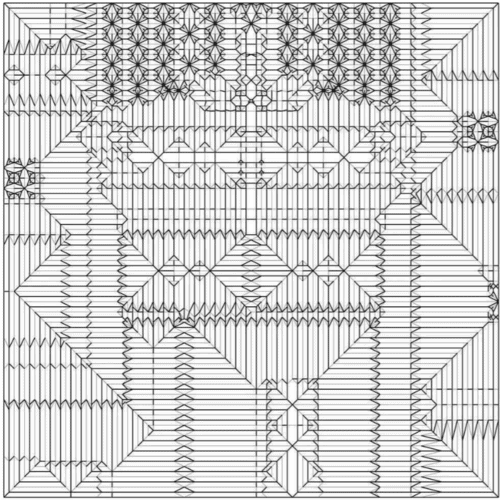
I don’t even know what this model is; there’s only one picture on the internet of the actual model, which means that I am reconstructing it from the crease pattern. It’s a big square full of the lines, used to describe how to fold the model. You could compare the crease pattern to a note sheet of music. You need to be able to read it to see.
EL: Mikael showed me the crease pattern for this model. It’s a 96×96 grid with all these diagonals on it. I reckon if you shook it too fast in front of someone’s face, or spun it around, they would have a seizure in response. It’s that level of density.
MK: It’s rough but super fun. I’m actually figuring it out, which is great. I’ve been sitting with that all day; how about you?
EL: Not doing that. I’ve been working on my leather work, and have almost finished my Cthulu bag, so I’m happy about that. I haven’t finished it, just got the panels done.
Look how wholesome we are, locked down during the Rona and doing arts and crafts.
MK: I’m not really locked down in Sweden, but still spending all my time folding things.
EL: Maybe you should be locked down.
Anyway, let’s get on with it. We are on a minisode, which means it is time for our listeners’ questions. As usual, if you want to ask any questions about any aspect of hand balance – your own personal training, whatever. Just DM them to us on social media, or to Handstand Factory as well. We have a contact form on the website. Also, if you have ideas for episodes, something we haven’t covered, shoot them over and we’ll see what we can do. If we use your idea, we’re not going to credit you. Let’s phase, good ideas aren’t made. They’re stolen. But deep down inside we’ll feel bad about stealing your idea and presenting it as our own.
Right. First question. It’s one of those complicated but simple answer ones. How do I know where I’m at in my handstand progression strengthwise?
MK: That’s very unspecific. Where you are in the progression…unless we know your specific training, who you are, what you’re doing and so on, it’s really hard to know where you’re at, strength wise. That will depend on where you were yesterday and so on.
EL: There’s no grading or set things in handstand, other than, if you can’t press then you are weak. It’s very binary. If you can’t press you’re weak. If you can’t stalder you’re not a person. Once you can stalder, you claim your own name. That’s when we’ll be like, his name was Robert Paulson. Until that point, you just have no name. You’re just a blank in Project Mayhem.
MK: We need to dig further into this hand balancing + Project Mayhem metaphor.
EL: Instead of soap we’ll sell handstand blocks.
MK: Or soap handstand blocks. That’s made from liposuction clinics.
EL: Anti bacterial as well, so your hands don’t get the Rona off the floor.
MK: To slightly return to the question, there isn’t a direct progression curve with handstands like with weightlifting. If you can lift 60, you put on more weight, then 62.5 and so on. It’s more complicated than that. The levels are more dependent on the guidelines, that you must be able to do A before moving onto B.
Speaking directly strength wise for handstands, a lot of things aren’t about strength either. It’s about building the strength you need before making it more efficient, and so on. It’s basically the type of question that is too hard to answer directly. There is a lot of specific information needed to say anything about a person.
EL: The main thing to consider for yourself is: are you getting better, and are you having fun? Do you feel like you’re progression your practice over the short/medium/long term? If you are, then you are getting stronger. Understand that there’s no real way to know, other than just keeping track of what you’re doing, making sure it’s getting better.
I think only in the beginner stage you can be quite linear in your progress. You’re doing chest to wall, doing 30s, and next week I’m doing sets of 35-40s. Then you’re increasing.
Obviously reps on presses and handstand pushups count, but…
MK: Like we’ve spoken about before, there’s lots of quality work. If you can only stand 35s but last week you did 40, maybe you actually improved in other measures. These count as well towards progression. It’s a complicated picture.
EL: If only you could measure in terms of sets and reps. We’re going to do 4 sets of art, and then one set of movement quality….
MK: That’s really great contemporary art. We could make that, easily apply to an art academy saying, you’re going to make sets and reps of art. It sounds perfect, super contemporary.
EL: Next question. How did you guys meet and decide to collaborate on these programs?
MK: I guess it was that first time when you came to Fight Club, and I said, if this is your first night at Fight Club then you have to fight. Then you got knocked out and shit, and the next time you beat the shit out of that guy.
EL: We’re not meant to talk about that.
MK: When was it? First we had a bit of contact online in the glory days of the Gymnastic Bodies forum.
EL: Mikael was chief shit poster there. I was posting a little bit, but not really. This was back when it was amazing. It had Yuri, Ido, MIkael, me. Coach Sommer hadn’t gone weird. It was a great time for the internet and sharing things.
I knew Mikael had just started circus school when I was kind of at the end. I spotted him and was like, oh this guy knows what he’s doing, he’s pretty cool. He had this eager way of trying to figure out, possibly in that egotistical 20s way of “I can find a better way to do this than what my coaches say.” And sometimes it turns out you can. You had that inquisitiveness that showed this guy wants to understand things without coming off as an asshole. I put him down on my radar to meet. Then a few years later, possibly even maybe years later….5-6 years later, or something like that, Mikael was teaching in Berlin. I wasn’t even training that much handstands at the time. I don’t even remember what I was training then.
MK: You guys were living in Berlin.
EL: Yeah. I was like, I know this guy from online, let’s give him some money and hopefully the workshop will be good. We gave him some money; the workshop was very good. Okay, so this guy knows what he’s talking about. I came out of my handstand retirement. He complimented me on my shoulders, thank you. Anyone who compliments my shoulders gets a thumbs up.
We started chatting after that. Did we go drinking? No…did we go for dinner at all?
MK: Dinner, we did. The Handstand Factory came along a few years later when we were chitchatting about various teaching methods, teaching online. Both of us had done coaching both in person and online. We thought, fuck it. There was a lot of material about teaching handstands online, in various quality. There were none we were in full agreement with, especially when it came to the one arm stuff. There was very little out there.
We decided why not make it ourselves?
EL: We met up somewhere along that time. Motion Impulse was organizing both of our workshops at that stage. We met up somewhere. I can’t remember where we were, but we were doing our favourite pastime of ripping on this particular one arm handstand program that is online. It will remain nameless. But Mikael finally said at one point, instead of criticizing this we should make something better. That made sense. Fuck bitching about something, make something better.
There’s a moral to the story if you’re bitching about shit. Just make something better, or shut up. Either way your life will be better.
Then we were like, let’s make a film…or film a program. We had the core of our handstand teaching, and did various bits and pieces. It took about a year to get something together. We decided we wanted to make the programs good. We could have filmed something on an iPhone and just put it out as a program, and people would have been like, that’s a good program.
But we wanted to get a proper film crew, proper editing, a website. It was a very big learning experience for all of us along the way. We got all that, and here we are now, filming even more programs. Hopefully we’ll hopefully have a textbook on handstands at some point.
MK: That kind of sums it up. Now we’re sitting here talking nonsense to you guys and using Fight Club analogies.
EL: What more do you want? First rule of Handstand Club is you tell everyone about Handstand Club.
So next question coming up is really cool. We have an audio question. If you want to hear your voice on the radio – the podcast-io – if you go to Anchor FM, Anchor.FM, you can leave a call in. I guarantee that if you leave a call in we will play it. If you send us questions, sometimes we get a load of the same and group them together. You might not hear your words but your question will be answered.
But for the moment, until we get thousands of them, we will play them. Let us pause now and I will play this.
Caller: Hey Mikael, hey Emmet, how is it going? My name is Quok from Brisbane, Australia. Thanks for the podcast; I really appreciate you sharing your knowledge and experience on the handstand practice. Loving the sarcastic humour, so keep that going.
My question was about opening the shoulders. In the last podcast you talked about press to handstand, and I am one of those guys that does the mini planche to handstand, and I’ve been doing it for a while. I feel like when I get up into handstand my shoulders don’t open up because I’m so used to doing that planche lean to handstand.
So, any drills or tips to help with my alignment in handstand, particularly focusing on opening the shoulders? I can hold a handstand for about 20s, but the shoulders struggle to open up, and I struggle to create that nice straight alignment.
Any tips or drills would help. Thank you!
EL: So we have Quok from Brisbane. Hopefully he hasn’t gotten bored from the podcast and is still listening in.
There’s two birds to this question. He’s got this planche type press to handstand. When he ends up planching up, he ends up with very closed shoulders. Also his line isn’t super straight.
They’re kind of related in some ways. The other bit is, how do we straighten it out?
MK: If you planche your press, it means you’re moving your centre of mass over the hands by closing the shoulders a lot as you lean forwards. What very often happens then is you pull the heels up and keep the shoulders in front of the hands until you reach the handstand position. Then your shoulder will likely still be slightly in front of the hands. Basically, the planche press is executed in a muscularly similar way to grabbing a dumbbell with a straight arm and lifting it over your head. That is the kind of pressure you exert.
If you do that with a dumbbell you will notice you don’t really use your trapezius in a way. You will lift up the dumbbell in front of you and will be heavy in the biceps and delts. When you arm reaches an overhead position, there’s no specific reason for your trapezius to be flexed at that point. You will then have to push with your trapezius to get on top of them and be using them. That is the issue that often happens with this kind of press. You lift it through and end up in a handstand but aren’t at all using the muscles that are by definition effectively stacking you.
In a “proper press,” the first thing you do is activate your trapezius as you lean forwards. You use your trapezius and push as high as you can to minimize the lean. You press up and then end up in a less planched position.
If this is your press, it is what it is at the moment. You should work on it and your mobility and so on. When you reach the handstand position, make sure you press through your trapezius and flex the shoulders extra. It won’t be intuitive to do when you’ve reached such a handstand position. It’s either often banana’d or still sort of diagonal planche-y.
EL: I think one of the other things is work the tuck handstand more. You’re doing 20s handstands; aim to be able to do a 30s closed tuck handstand. It will fix a lot of shoulder alignment issues. It’s pure shoulder flexion strength, the active side of the shoulder flexibility for a handstand.
Keep forcing it. It’s always this idea of intent in all these stretches, particularly with active flexibility stuff. I’ll get my shoulders elevated and my traps engaged, pushing up as high as I can. Then I keep forcing and forcing it as best I can. This is the idea of just keeping going with it. Tuck wall slides – anything tuck handstands basically is the key.
Tuck life. #Tucklife, bitches.
Right, where have my questions gone. The audio question was cool. Here we go: Am I a bad person if I train side splits with toes pointing upwards instead of feet on ground?
The answer is, you are a bad person, but it has nothing to do with your side splits variation of choice.
MK: Remember, it has to do with whether or not you can stalder press.
EL: What was your quote from your student recently?
MK: Something along the lines that the press to handstand was the metric with which she valued herself as a person.
It was obviously a joke; don’t take it too literally.
EL: No, take it literally. But also a lot of people get very obsessed with these movements.
The side splits pointing upwards instead of feet on the ground – the thing we have to clear up on the side splits is, if we just look at the bone level, there’s only really one way we can move the pelvis and femurs to get this side split line.
Imagine we don’t do anything with the lower legs and just keep them. If you’re doing with feet on the ground, if you look at peoples’ ankles when doing it that way, they’re generally quite contorted and inverted in. That’s what allows them to keep their feet flat on the ground. Some people are quite flexible and have a lot of range of motion, so it’s very easy for them. Other people, or I should say most people, have to spend a decent amount of time stretching this zone.
The reason I get called the Splits Wizard sometimes is I understand the techniques of these things. I’ll have someone come to me for a one off on side splits, or something like this. I see they’re trying to keep their feet flat on the ground and can’t get past a certain point. I say, lo and behold, my wizardry: roll your feet on the inside, or get your toes on the ground. Suddenly they drop 15, 20, 30º. I’ve seen some very big drops, because this side of the ankle is a limitation.
Then suddenly they have instant gain of ROM. They claim I’m Gandolf, and I say no, it’s just technique. Any advanced technology appears as magick.
You can create these limitations for yourself. But if you go, okay I’ll do my side split and I’ll just do what I want with my feet. When it gets flat, then you can choose and be able to do toes up, down or pointed. Whatever is comfortable.
One thing is, when we change the angulation it obviously changes which muscles are loaded. If we have toes up, it’s obviously more hamstrings loaded up by the vector. If you keep the feet forward it is more adductors – adductor magnus, the short adductors. So there is a bit of that.
Depending on where you’re tight, it could be good to train one variation that will unlock the other for you. There’s a few things in there.
You’re not a bad person…if you can press.
MK: Let’s keep it at that.
EL: Our last question for the podcast for this evening. I think I’ve only heard you mention yoga once, in episode one. They/you refer to it as the Y word. Is yoga evil? I’ve come to handstands from yoga. Interestingly, my yoga teacher doesn’t seem keen on my current passion and believes I should be getting my shoulder mobility up to scratch before doing handstands and crow pose. He seems to be concerned I will lock in the stiffness if I increase my shoulder strength without getting the mobility in place first. I am continuing my handstand passion because the desire to handstand is driving me to sort out my shoulder mobility. I’m interested in your thoughts – mobility first, or just do it?
A bit of a two parter. I’ll address the first one, because it was me saying the Y word. It was a bit of bait to yogis to see who would kick up a fuss. Let’s clear it up: it was a tongue in cheek comment because whenever I’m training in a park, or just hanging out, or meeting other circus people we know and doing some training, it’s likely that if someone comes over and talks about our flexibility or handstands, the next word out of their mouth is, “you must do so much yoga to get like that.” No, no. We do circus, we do acrobatics. That’s what we do.
It’s a bit of a trope. If you do circus…people probably don’t speak to you in Sweden, but if they did, they’d probably look at you and think, he’s really good at yoga.
So it was that, just some gentle fun and bit of ribbing, no harm intended. A little bit, I intended to bruise your pride just a small amount.
That’s the Y word thing. Circus performers have been called yoga people. Just to digress into the yoga world, a very big yoga brand, which will remain nameless so I don’t get sued, used to hire circus performs to perform in their shops. They’d get contortionists and hand balancers, just to demonstrate the equipment. People would be like, oh my god, you must do so much yoga. You can sit on your own head.
Mikael is currently working on that skill, by the way.
MK: To address that thing…handstands are used in yoga to some degree, and other arm balances as well. That’s totally fine. Within these various contexts of physical practice, or any practice, really, they are systematized. Then we tend to create these concepts and what I call myths regarding various parts of the practices.
This doesn’t just apply to yoga, but circus and dance. I’ve been quite observant of these things through the years because of my anthropology background, as that’s where they use concepts like ‘myth.’
Essentially, what I mean is, for example, your yoga teacher talking about “locking into stiffness” – if you look at that, what is the assumption? It’s that if you do the practice without your body being ‘perfect’ for it, you will ruin your structure and body.
First of all, a handstand is an artificial idea, as we talked about before. The old school gymnasts and performers used to do a banana back handstand. They were not injured or destroyed because of that. The body adapts to what you give it. You can perfectly fine load your body and do these things without your mobility being a problem, to a degree of course.
If you try to do some crazy moves at a very high level, you lack mobility and might hurt yourself.
For example, a crow doesn’t have much of a mobility component besides being able to flex your wrists enough to put the weight on them. I think just be aware of that. That is not ripping on yoga at all. It’s just a very typical thing I’ve heard in many fields.
There was, for example, a professional dancer and choreographer who was very skilled at great in their field and well respected. She saw our presentations in circus school and saw me do my handstands. Then she gave feedback to everyone. She came to me and said, when you stand on one arm, your elbow is moving. I said yeah, it does, that’s how you balance on one arm. “But that can’t be good for the joints!” What do you mean? “In dance, hyperextended knees aren’t good and they get hurt!” But this is what they all do.
It actually became a discussion where she extrapolated her idea of dancers jumping on hyperextended legs onto what I was doing. Yes, maybe dancers can get injured from hyper extended legs.
But as with most things, it’s about load versus tolerance. If your body can handle it, then it can handle it. If you do too much too early, you can get injured. It’s more about that than the very specific things you must or must not do. The things we do are things we’ve come up with, ideas or concepts. They’re fun to do.
On average, unless you try to do something crazy or super hardcore, you’re most likely not going to lock yourself into any stiffness, or get injured. That’s my spiel on that. Got anything to add to that, Emmet?
EL: I like the myth idea you presented. It occurs everywhere. You see these bad studies where they make people stretch then immediately attempt to 1RM squat, then say your power goes down. It extrapolates to all stretching is bad, and strength and power athletes shouldn’t stretch at all. You see it everywhere, in every single sport you can find these myths about training. They might be case specific, or might be general guidelines that then become Thou Shalt Not.
I remember we had a ballet teacher, and a few classes with her. You weren’t allowed to drink water in her class because it would put off your centre of mass and you would be bad at ballet.
MK: I also did a class with a circus person who told me not to drink water in class, because it will go to your muscles, which is bad. Imagine that. You grow up, do circus classes and hear that. You make the strong assumption on something that is absolutely nonsensical. There’s a lot of this happening in various training communities. I remember when I was doing breakdancing too. We had all these weird ideas that came up because we were kids that had no idea about anything. We just started doing things because we heard something.
“You should do 100 push ups every evening. yeah, that’s good.” Then people started doing 100 push ups every evening. I mean, people survived, but it wasn’t optimal in any sense.
I’ve seen this a lot in circus as well. It’s just something to be aware of, and I think it’s very important to have critical thinking around these sorts of topics when it comes to absolute statements on whatever is good or bad, injuries or whatnot. Very few things are 100%.
EL: I suppose it’s like Bro Science, as they say in bodybuilding. Sometimes it works, but sometimes it’s like, “you must drink your protein shake within 15 minutes of finishing your workout, or else you lose muscles.” A friend of mine who will remain nameless forgot his protein shake so he got a taxi home from the gym, which cost about 15 quid, just so he could get back in time to not ‘lose his gains.’
We have to be careful about these myths.
Just to throw it out there: if you want to learn to develop balance, alignment, active or passive flexibility, and the handstand, all in one go, we conveniently have a course on Handstand Factory called Push that will teach you all these things at once. It’s working very well for the people out there. #shamelessplug.
Other than that, that is all our questions for tonight’s episode. As usual, thank you for listening. If you have questions, send them to us on Anchor FM so we can hear your voices. Other than that, thanks for tuning in.
MK: Cheers.
References
- Handstand Factory courses
- Emmet Louis Instagram
- Mikael Kristiansen Instagram
- Handstand Factory Instagram
- Anchor
- Mikael’s Ne Zha pattern for origami: